The Cementary Feeling the Forest Again
The Bali hamlet with a magic tree
(Image credit:
Sioen Gérard/Alamy
)
Bali Aga villagers get out their expressionless to decay in the open air, below a magic, ancient tree that is said to stop the corpses from smelling.
"My cousin is over there," my guide Ketut Blen explained, pointing to a skull and package of habiliment beneath a tatty palm and bamboo frame. "Just I don't feel anything when I look at him."
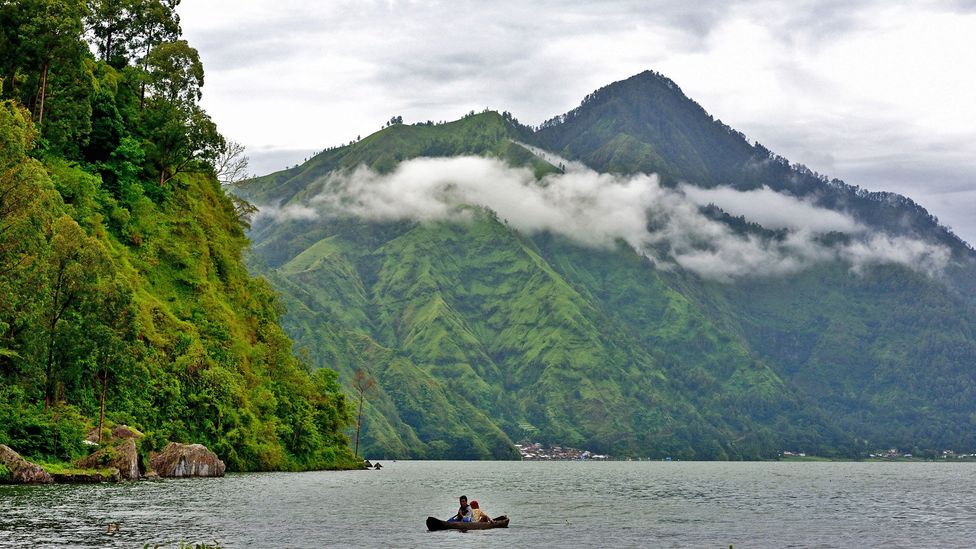
The cemetery in Trunyan, Bali, where villagers canvass their dead in canoes to rot in the open air, is an isolated identify. Shielded by steep and jungled slopes, information technology rests on the shores of a vast highland crater lake, a short boat ride from its parent hamlet. And, on an isle where nigh Balinese Hindus cremate their dead, Trunyan is unique.
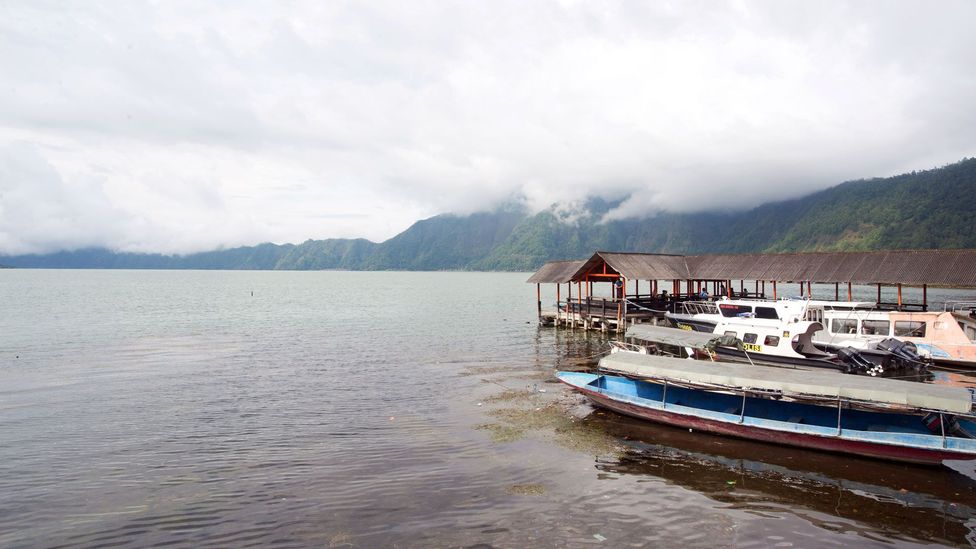
The Bali Aga people live in remote and isolated villages in northeast Bali (Credit: Theodora Sutcliffe)
Blen's Bali Aga people, who live in typically remote and isolated villages mainly in northeast Bali, are some of the island'south oldest inhabitants: Trunyan dates back to at least 911 CE. Similar virtually Balinese, the Bali Aga follow Bali's eccentric make of Hinduism, but every village cluster, like the group of villages Trunyan heads, also has its own religious rituals and beliefs.
In Tenganan, the most famous Bali Aga village, that ways spinning marriageable young women in bamboo Ferris wheels and weaving magic cloth. In Trunyan, that means ritual whipping with rattan shoots and exposing the dead to rot in the open air.
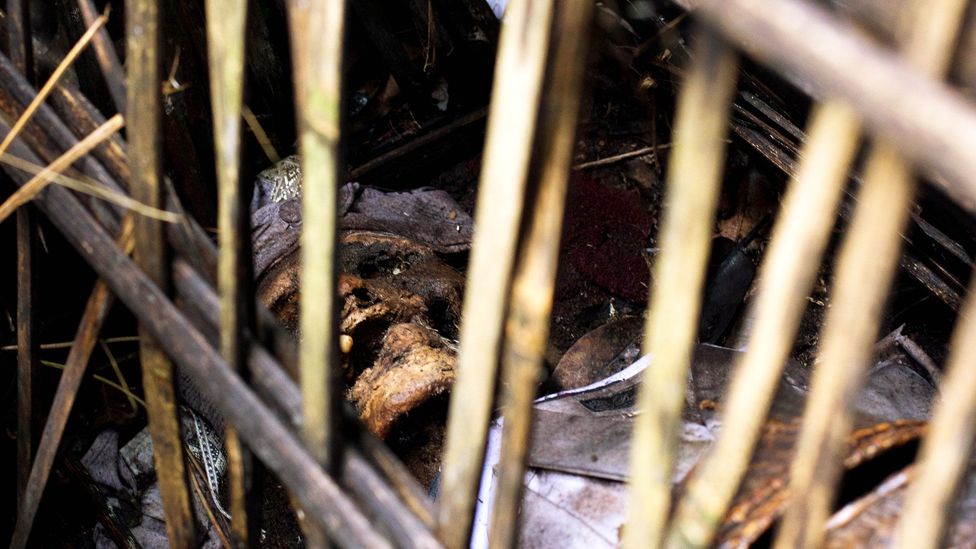
There are 11 arched palm and bamboo cages in the cemetery (Credit: Theodora Sutcliffe)
There are actually two cemeteries in Trunyan, Blen explained, with this one reserved for those whose life'due south journey counts as consummate.
"Everyone here had been married when they died," he said. "People who die before they are married, or drown in the lake, we put in the earth."
Faith in Trunyan is even more dense with animism than almost Balinese Hinduism. The village, dominated by a grand temple whose 11 pagodas mirror the 11 corpses exposed in the cemetery, has a perilous location. It perches below an active volcano on the shores of a choppy crater lake, imperilled by the twin natural dangers of fire and water.
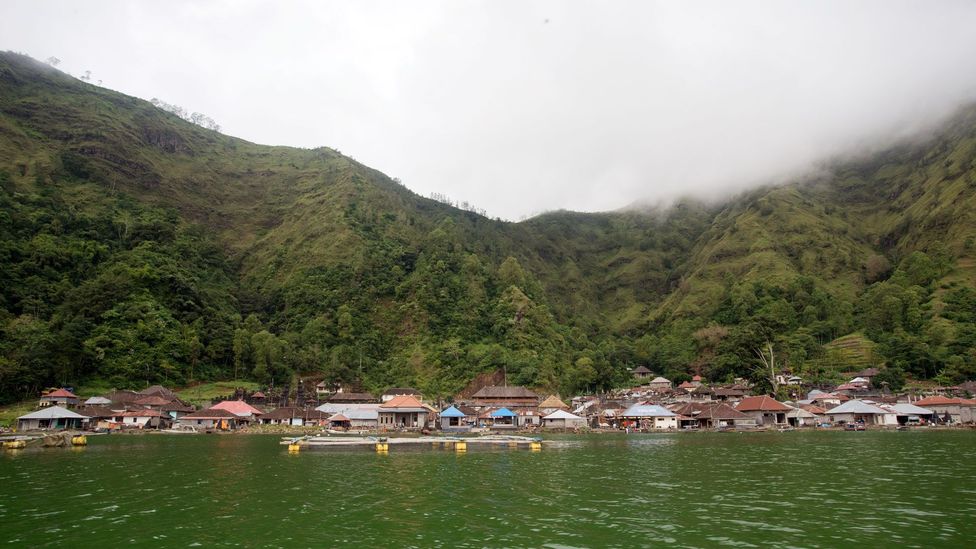
Arriving at Trunyan (Credit: Theodora Sutcliffe)
The volcano, Mount Batur, has shaped both decease and life here for centuries.
"Here we have the volcano," Blen explained. "So it'due south non possible to burn people. It could crusade a problem with the volcano."
Originally for fright of enraging the volcano – now identified every bit the Hindu god Brahma – the dead are left to rot. The number 11 has rich significance in Hinduism, so there are just 11 arched palm and bamboo cages in the cemetery; once all are filled, villagers move the oldest remains to an open-air ossuary.
That'south if there are remains left to move. Oft, the basic but disappear – victims, I assumed, of the monkeys that whoop in the woods and feast on food offerings left for gods and corpses.
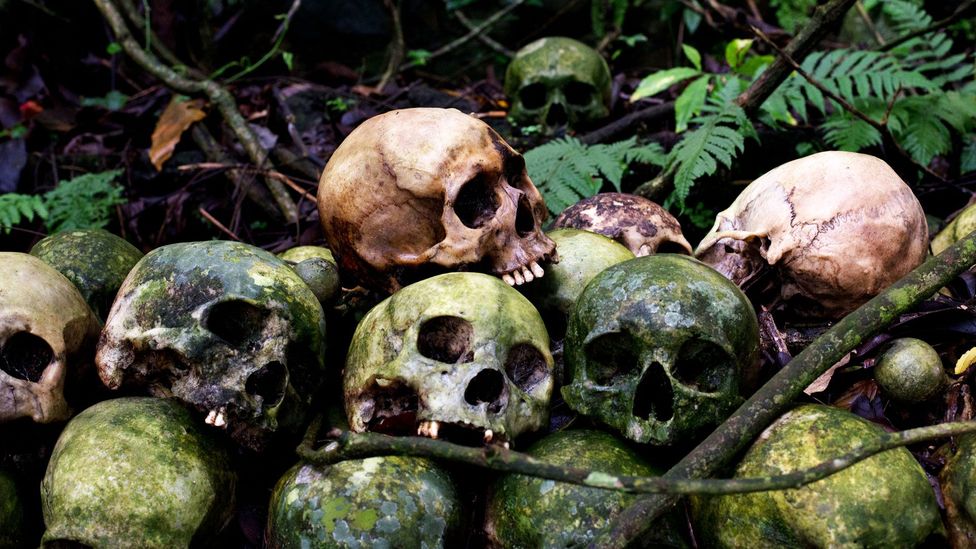
An open-air ossuary (Credit: Theodora Sutcliffe)
And yet, for all the litter and grime that fills the cemetery – a homo thighbone casually discarded abreast an ancient flip-flop amid a clutter of empty dishes – the identify had a strange serenity. Bizarrely, there was no aroma of death. The corpses, shielded by bright umbrellas and dressed in their favourite clothes, felt at peace. And the gaze of the skulls in the ossuary seemed calm, their journey over and spirits flown.
The about recent add-on to the graveyard was the hamlet priest, or mangku, who died 26 days before my visit; Blen's cousin had been in that location months. Considering bodies may merely be brought to the cemetery and its adjoining temple on auspicious days, and the family has to heighten coin for the funeral, some corpses stay at home for days or weeks beforehand. Villagers use formaldehyde to stop their loved ones rotting over the long wait.
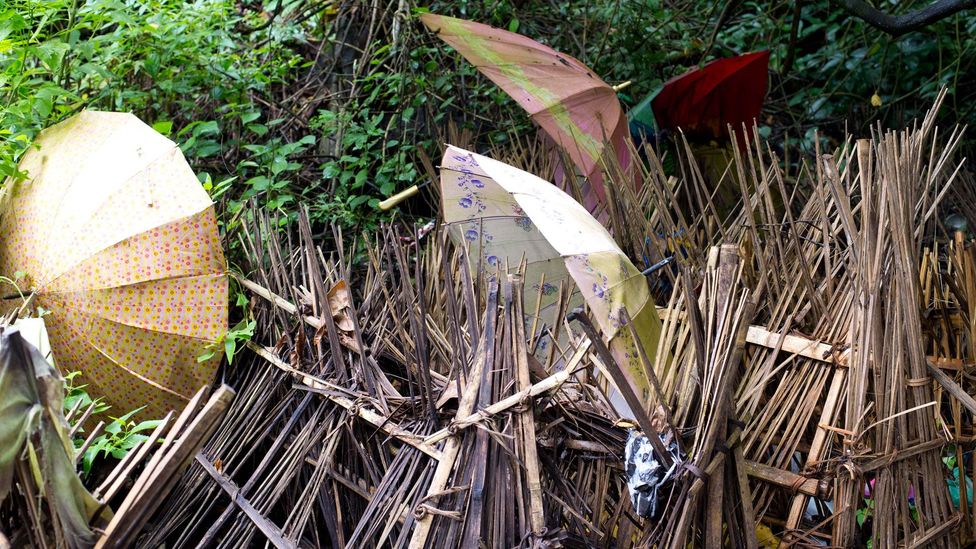
Once the cages are filled, villagers motility the oldest remains to an open up-air ossuary (Credit: Theodora Sutcliffe)
The hillside village of Puser, part of Trunyan'south cluster, also has an open-air cemetery. As our gunkhole passed, the rubbish-dump reek of rotting bodies was axiomatic 100m out on the water.
Only as we arrived in Trunyan cemetery, at that place was no odour at all. I looked through a palm leafage muzzle into the empty eyes of a human whose blackened flesh however clung to his skull, and caught only the faintest whiff of decay.
There is more than formaldehyde to the missing stench, information technology seems. A towering, tangled, mossy tree that looks like an aboriginal banyan dominates the open-air cemetery. Locals believe that the tree, called Taru Menyan, or "fragrant tree", overpowers the rotting scent.
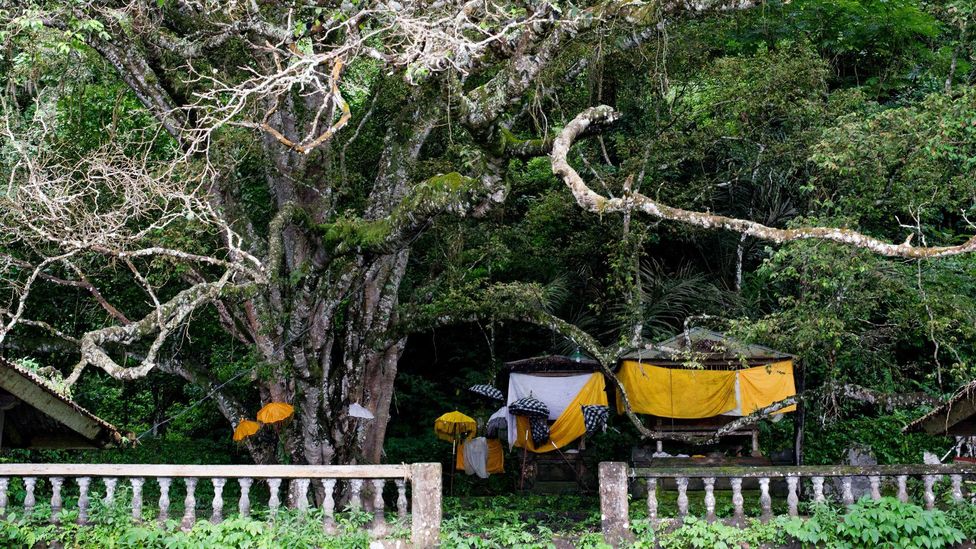
The corpses are shielded by bright umbrellas (Credit: Theodora Sutcliffe)
"This tree is magic," explained Blen's friend, Ketut Darmayasa. "At dwelling the bodies would smell. Here, it'southward only because of the tree."
It's not just the death ritual and the magic tree that makes this lakeside line-fishing village unusual. The entire village nonetheless gathers to brand communal decisions at the bale agung, a cluster of open up-air platforms that form the heart of the 3-tiered village. And once a year, around October, the immature men wearing apparel up in elaborate costumes of fringed banana foliage and brandish rattan shoot whips in a ritual dance chosen Brutuk. Its aim? To sanctify the temple, thus keeping the hamlet and villagers safe.
Only it's the cemetery, with its strange repose, that defines Trunyan. And there, surrounded by reminders of the mortality we all share and the decease that will come to all of us, I asked Blen how he could look at the decaying remains of the cousin he had loved and non feel grief.
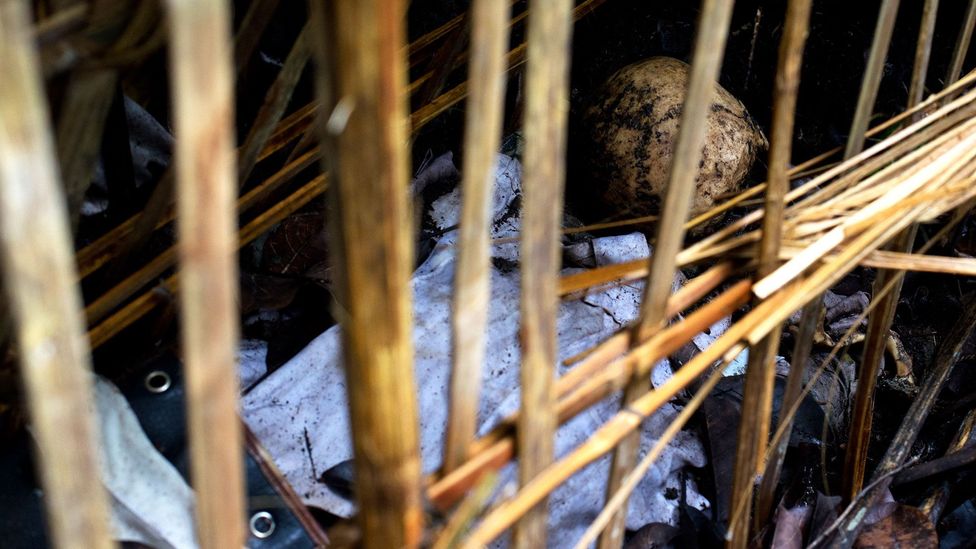
The decaying remains of a loved one (Credit: Theodora Sutcliffe)
He and Darmayasa discussed a while in Balinese. "He is only distressing at abode," Darmayasa said. "[In the cemetery] he doesn't feel any grief."
"Why" I asked once again.
"Considering it'south our culture," Darmayasa said just.
For in Trunyan, as everywhere, both expiry and grief are cultural acts: it's just more than obvious here.
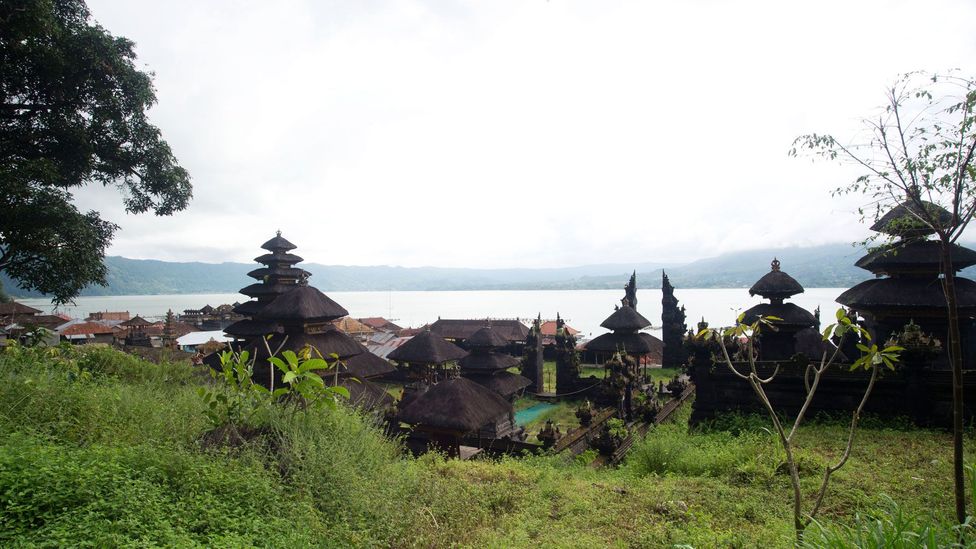
A view of Trunyan's grand temple (Credit: Theodora Sutcliffe)
If you liked this story, sign upwardly for the weekly bbc.com features newsletter , called "If You lot But Read 6 Things This Week". A handpicked selection of stories from BBC Future, Earth, Civilisation, Upper-case letter, Travel and Autos, delivered to your inbox every Friday.
Source: https://www.bbc.com/travel/article/20160606-the-village-that-sails-their-dead-to-rot
0 Response to "The Cementary Feeling the Forest Again"
Post a Comment